
Getting a speeding ticket, causing an accident, or picking up a DUI in Georgia can turn a routine insurance renewal into a stressful search for coverage. Standard insurers often raise rates sharply or decline to renew a policy altogether, leaving drivers unsure where to turn or what they’ll actually pay next.
This guide walks through what actually makes a driver high risk in Georgia, how that label changes pricing and coverage options, and what the state legally requires regardless of driving history. It also covers real average costs by violation type, ways to lower premiums without cutting needed coverage, and how long high risk status typically lasts before rates start coming back down.
About the Author
Insurenestly operates strictly as a research platform. The team does not sell policies, quote rates, or act as an agent or broker for any insurance company. Every article is built from public data and industry sources, then reviewed for accuracy before publishing, so readers get an independent, unbiased starting point before they contact a licensed provider.
Who Qualifies as a High Risk Driver in Georgia?
A high risk driver is someone an insurer views as more likely to file a claim than average. There’s no single industry wide definition of the term each company sets its own criteria, so the same driver can be labeled high risk by one insurer and standard by another. Once marked high risk, a driver typically sees higher premiums to offset that added risk.
Not every insurance company judges risk the same way. Each insurer uses its own underwriting guidelines, meaning one company may treat a violation as minor while another sees it as a red flag. This is why a driver labeled high risk by one insurer may get a lower rate from another, and comparing quotes matters.
Driving Violations That Increase Insurance Risk
Certain traffic violations push a driver into the high risk category faster than others. Georgia insurers pay close attention to:
- Speeding tickets, especially repeated ones
- Reckless driving convictions
- Multiple traffic violations within a short period
Georgia only adds points for speeding if the driver was going more than 15 mph over the posted limit, but points still build up with other moving violations too. Repeated violations signal a pattern of risky driving rather than a one time mistake, and insurers price policies based on patterns. The more violations on record, the more an insurer expects a future claim, which is why rates climb with each new infraction.
Accidents, DUI, and License Suspensions
Some events carry more weight than routine tickets because they point to serious risk. These include:
- At fault accidents, especially with injury or major property damage
- DUI convictions
- License suspension or revocation
A driver’s license is suspended in Georgia if a driver receives 15 or more points within 24 months, and just one DUI conviction is enough for a driver to be classified as high risk and required to carry SR 22 insurance in the state. A suspended license doesn’t just affect driving privileges; it also limits which insurers will offer coverage at all, often pushing drivers into non standard or high risk insurance programs with steeper premiums.
Other Factors Insurers Consider
Beyond violations and accidents, insurers also weigh factors that aren’t about how someone drives but still affect risk on paper:
- New or inexperienced drivers with limited history
- A previous lapse in insurance coverage
- Past claims history, even without fault
- The type of vehicle being insured
- Annual mileage driven
- Credit-based insurance score, when permitted by the state
A new driver with a coverage lapse and a sports car will typically see a much higher quote than an experienced driver with none of those factors, since insurers weigh several details together rather than pricing off one alone.
How High Risk Status Affects Your Car Insurance

Once a driver is classified as high risk, the biggest change is cost. Insurers charge more to offset the added risk, and some standard companies may decline to offer a policy at all. This shift often pushes drivers toward specialized insurers who focus on non standard, higher risk applicants.
Policy availability changes too. Not every insurer sells coverage to high risk drivers, so the pool of companies willing to quote a policy shrinks. Pricing also becomes more individualized, since insurers look closely at the specific violation, accident, or history behind the high risk label rather than applying one flat rate to everyone.
Why Premiums Become More Expensive
This pricing approach is known as risk based pricing insurers and lenders alike charge higher prices to customers with a higher risk profile, rather than spreading the cost evenly across all policyholders.
A DUI conviction alone can raise rates by around 106%, an at fault accident by about 43%, and a speeding ticket by roughly 21%, which shows why violations don’t all carry the same weight. Two drivers with different records, even in the same city, can get very different quotes because each insurer weighs past behavior differently when predicting future claims.
Coverage Options Available to High Risk Drivers
High risk drivers can still access most of the same coverage types as any other driver, though pricing and availability shift by insurer. Common options include:
- Liability coverage
- Collision coverage
- Comprehensive coverage
- Uninsured/underinsured motorist coverage
Not every insurer offers every option to a high risk applicant. Some non standard carriers limit coverage to state minimum liability only, while others still offer full coverage at a higher price. What’s available really depends on the specific insurer and how they view the driver’s risk profile, so comparing quotes matters more for high risk drivers than for anyone else.
Can an Insurance Company Deny Coverage?
Yes, insurers can decline to offer a policy. Standard companies often reject applicants with a serious violation, multiple claims, or a DUI on record because the risk doesn’t fit their underwriting guidelines.
When this happens, non standard insurers become the main option, since they specialize in covering drivers that standard companies turn away. Georgia also has a state backed safety net called the Georgia Automobile Insurance Plan (GAIP), which drivers can access after being rejected by at least two Georgia licensed insurers within 60 days. If coverage is denied, a driver’s best move is to keep applying with other insurers or non standard carriers and use GAIP as a last resort if the standard market keeps saying no.
Georgia Car Insurance Requirements for High Risk Drivers
Georgia law requires every driver to carry the minimum amount of car insurance coverage needed to legally operate a vehicle, with no exceptions. This includes high risk drivers. Being labeled high risk doesn’t lower or change the legal requirement; it just usually means paying more to meet it.
The same minimum liability rules apply whether a driver has a clean record or a DUI on file. The difference isn’t in what the law requires but in how much an insurer charges to provide that coverage, and which companies are willing to offer it.
Minimum Liability Coverage Limits
Georgia law requires all drivers to carry at least $25,000 per person and $50,000 per accident in bodily injury liability coverage, and $25,000 in property damage liability coverage, commonly written as 25/50/25.
- Bodily injury liability: covers one injured person’s medical bills, lost wages, and other damages if you cause an accident, up to the per accident total
- Property damage liability: pays to repair or replace the other driver’s vehicle if you cause an accident, and also covers damage to fences, mailboxes, or public property like utility poles and traffic signs
These limits apply to every registered driver in Georgia, including those labeled high risk.
When SR 22 May Be Required
An SR-22 is not an actual insurance policy. It’s a certificate your insurer files with the Georgia Department of Driver Services confirming you carry the state’s required coverage. Common situations that trigger it include:
- A DUI or DWI conviction
- Driving without insurance, particularly after causing an at-fault accident
- Reckless driving convictions
- A license suspension or revocation being reinstated
Not every high risk driver needs an SR 22. A driver with several speeding tickets, for example, may pay more for insurance without ever being required to file one. The requirement usually comes from a court order or a DDS decision, not from the insurer itself.
Penalties for Driving Without Insurance
A first offense carries a fine between $200 and $1,000, plus a $25 lapse fee, and a misdemeanor charge on the driver’s record. License suspension starts at a minimum of 60 days for a first offense and at least 90 days for repeat offenses.
- Registration suspension: alongside the license, until proof of a new policy is provided, with a registration reinstatement fee of $60 on a first offense and up to $160 on later offenses
- Jail time: up to one year, with jail more likely to apply once there are two or more offenses
To reinstate a suspended license, drivers must provide proof of a prepaid six month insurance policy and pay a reinstatement fee between $200 and $410, depending on their violation history and payment method. These added costs make driving without insurance much more expensive than the initial fine alone.
What Is the Cost of High Risk Car Insurance in Georgia?
There’s no single number that applies to every high risk driver. Georgia insurance pricing depends heavily on what’s behind the “high risk” label, since a speeding ticket and a DUI don’t carry the same weight with insurers.
Two drivers with the same “high risk” tag can pay very different amounts. The exact violation, how long ago it happened, and which insurer is quoting all shift the final price, sometimes by hundreds of dollars a month.
Average Rates by Driving Record
Georgia’s full coverage average for a clean driving record is $149 a month. Here’s how that number shifts with different history:
- Clean record: $149/month
- Speeding ticket (11–15 mph over): $180 a month, a 21% increase
- At fault accident: $213 a month, a 43% increase
- DUI conviction: $316 a month, a 112% increase
- SR 22 requirement: typically $76 or more per month above standard rates, on top of the underlying violation’s surcharge
These are averages, not guarantees. A driver’s exact quote can land above or below these figures depending on the insurer.
Factors That Have the Biggest Impact on Price
Beyond the driving record itself, several other details shape the final quote:
- Driving history and how recent the violation is
- Age, since younger drivers pay significantly more
- ZIP code and local accident or theft rates
- Vehicle make and model
- Coverage limits selected
- Deductible amount chosen
- Overall claims history, even without fault
Georgia rates can vary by more than $670 a month depending on a driver’s age, insurer, credit score, driving record, coverage level, location, and vehicle. No single factor decides the price alone; insurers combine all of them.
How to Estimate Your Premium Before Buying
Rate spreads for high risk drivers can be wide even in Georgia’s assigned risk market GAIP coverage typically runs 60% to 90% higher than a comparable voluntary market policy for the same limits, which is why checking standard insurers first is worth the extra step.
When comparing quotes, make sure each one uses identical coverage levels, limits, and deductibles. Comparing a state minimum quote against a full coverage quote makes one look artificially cheaper, even though the actual protection is very different. Matching every detail across quotes is the only way to see which insurer truly offers the best price.
Ways to Lower the Cost of High Risk Car Insurance
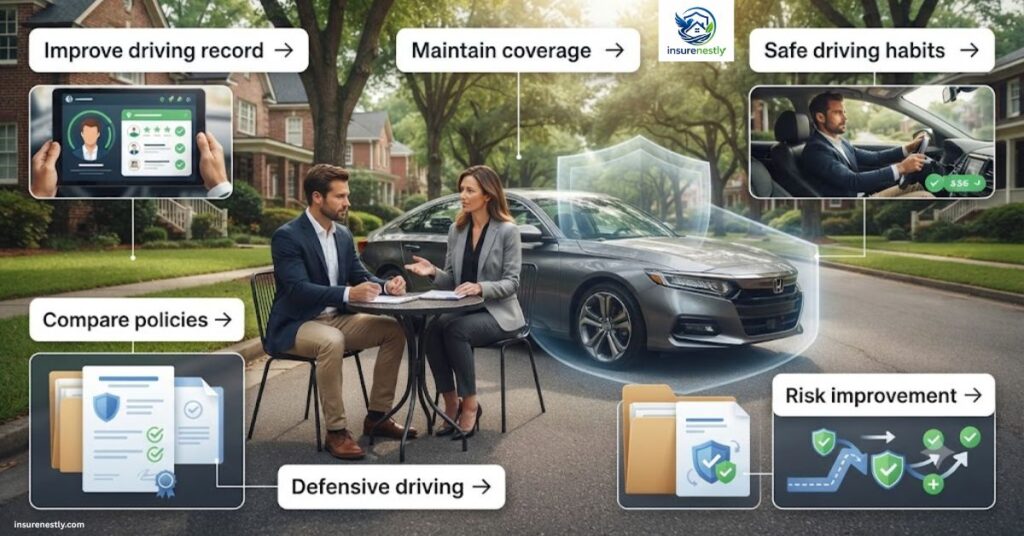
Being classified as high risk doesn’t mean paying the highest possible rate forever. There are practical ways to bring costs down without dropping coverage you actually need, and most of them are within a driver’s control.
Compare Quotes From Multiple Insurers
Auto Owners is currently the cheapest carrier for Georgia high risk drivers with a speeding ticket, averaging around $111 a month for full coverage, while distracted driving violations average closer to $100 a month with the same insurer a gap wide enough to make shopping around worth the time.
When comparing, make sure each quote reflects identical coverage, the same limits, and the same deductible. Comparing mismatched policies makes one look cheaper on paper while offering far less protection. Getting three to five quotes side by side is the only reliable way to spot the best deal for a specific driving history.
Insurance Discounts Available for High Risk Drivers
Even with a violation on record, several discounts can still apply and help offset the higher base rate:
- Multi policy discount, for bundling auto with home or renters insurance
- Multi-vehicle discount for adding more than one car to the same insurance policy
- Defensive driving course completion
- Paperless billing
- Automatic payments
- Safe driving or telematics programs, where the insurer offers one
Georgia law guarantees a reduction of at least 10% in insurance premiums for licensed drivers 25 or older who complete a six hour defensive driving course, though a driver must have a clean record for the past three years to qualify. This makes it one of the more reliable savings options for drivers trying to rebuild a clean history.
Coverage Choices That Can Reduce Premiums
Adjusting coverage itself, not just shopping around, can also lower a high risk driver’s monthly bill:
- Increasing your deductible for collision and comprehensive coverage
- Removing comprehensive and collision on older, lower value vehicles
- Choosing policy limits that match actual risk instead of the bare state minimum
- Avoiding being underinsured just to save a few dollars a month
A higher deductible lowers the premium but means paying more out of pocket after a claim, so it should match what a driver can realistically afford. Dropping coverage on an older car makes sense once the vehicle’s value is low, but cutting liability limits too far to save money can leave a driver exposed to costs far higher than what they saved.
How Long Will You Stay a High Risk Driver?
High risk status fades with time rather than staying fixed. Most insurers reduce a violation’s impact on price gradually a speeding ticket carries less weight the longer it sits on record, and its effect typically disappears once the three year window closes.
How Long Violations Stay on Your Record
Different violations affect a driver’s record and insurance rates for different lengths of time. In Georgia, violations affect a driver’s insurance rate for three years from the date of the incident. A DUI works differently: it stays on a driver’s Georgia record for 10 years, though most insurers only raise rates for three to five years following the conviction.
These are general timelines, and exact periods vary by insurer and by state, since each company sets its own look back window for pricing. A driver moving between states or switching insurers may see a different timeline applied to the same violation.
When Your Insurance Rates May Improve
Rates typically start improving once a few conditions line up:
- A clean driving record without any recent violations
- No new claims filed
- Reaching a policy renewal date, when insurers re check the driving record
- Re shopping for insurance with a fresh, cleaner history
Insurance companies usually review risk factors at renewal time, so drivers who maintain a violation-free record may receive lower rates simply by keeping a clean history over time. Re shopping matters too, since some insurers weigh older violations less heavily than others once enough time has passed.
Habits That Help Restore Lower Premiums
A few consistent habits make the biggest difference in getting back to standard rates:
- Driving safely and avoiding new violations
- Steering clear of accidents, especially at fault ones
- Keeping continuous coverage without any lapse
- Paying premiums on time every cycle
- Reviewing the policy regularly to catch outdated coverage or missed discounts
None of these guarantee an instant drop in price, but together they rebuild the driving history insurers look at most. A driver who stays consistent on all of these usually moves out of high risk pricing faster than one who only fixes one habit at a time.
Conclusion
Being labeled a high risk driver in Georgia isn’t the end of affordable coverage, it’s just a temporary phase that comes with higher costs and fewer choices. Understanding why insurers see a driver as risky, and what the state actually requires by law, makes it easier to find a policy that fits without overpaying.
The fastest way forward is staying proactive: compare quotes regularly, take advantage of every discount available, and keep the driving record clean going forward. Rates rarely stay high forever for drivers who follow through on these steps.
Disclaimer
Insurance rates, laws, and requirements change frequently and can vary by insurer, driving history, vehicle, and location. The figures and averages shared here are for general informational purposes only and should not be treated as a guaranteed quote or legal advice. Always confirm current rates and coverage requirements directly with a licensed insurance provider or Georgia’s Department of Driver Services before making a decision.
Reference and Source
MoneyGeek – Best Cheap High-Risk Auto Insurance in Georgia
Price Disclaimer
All prices, rates, and cost figures mentioned in this article are based on research from publicly available industry data and third-party sources at the time of publication. These figures are for general informational purposes only and represent averages, not guaranteed quotes. Insurance rates can change at any time and vary based on your driving history, insurer, location, coverage limits, and other personal factors. For accurate, up-to-date pricing specific to your situation, please contact a licensed insurance agent or provider directly.
FAQS
Which Companies Insure High Risk Drivers?
Standard insurers like USAA, State Farm, and American Family tend to be more forgiving after a violation, with smaller rate increases than other companies. Non standard insurers such as Direct Auto, Kemper, The General, and Dairyland focus specifically on high risk drivers when standard companies decline coverage. Comparing both types is the best way to find the right fit.
Can I Get Affordable Coverage?
Yes, though “affordable” looks different for a high risk driver than for one with a clean record. Auto Owners is currently the cheapest option for high risk drivers in Georgia, averaging around $93 a month for liability coverage. Comparing multiple insurers, not settling for the first quote, is what usually brings the price down the most.

Shumail is an independent insurance researcher and content writer who researches publicly available insurance information and explains coverage, costs, and insurance concepts in simple language. InsureNestly provides educational and informational content only and does not sell insurance or provide insurance advice.