
If you are buying a home or already have a mortgage, you have probably heard the term hazard insurance. Lenders often bring it up because they want to make sure the house stays protected. Many homeowners feel unsure about what it really means and why it matters for them.
Hazard insurance is typically not a separate policy. It forms the main part of your regular homeowners insurance that covers the physical structure of your house. Coverage can change depending on the insurance company, your policy details, and where you live. This article is for information only and is not insurance or financial advice. Please talk to a qualified professional for your specific situation.
Written by Shumail at Insurenestly
Shumail is an independent insurance researcher with over 5 years of experience studying homeowners insurance, hazard coverage, and related topics. He is not an insurance agent or service provider.
His goal is simple: to gather clear, practical information so regular homeowners like you can understand your options and make better decisions. All content on Insurenestly comes from careful research and real world policy details.
Author Profile: Visit Shumail’s Author Page
What Is Hazard Insurance for Home?
If you have a mortgage or plan to buy a house, you will likely hear about hazard insurance. Many people feel confused by the term at first. In simple words, it is the coverage that protects the actual building of your home from sudden damage. I have researched insurance topics for years and seen how this one piece brings real peace of mind to homeowners.
How is hazard insurance defined?
Hazard insurance protects your home’s physical structure walls, roof, foundation, floors, and built in items like plumbing or cabinets from certain covered perils. These include fire, lightning, windstorms, hail, falling trees, explosions, and vandalism.
Lenders often require it when you have a mortgage because they want to protect their investment. If something bad happens to the house, the coverage helps pay for repairs or rebuilding so the bank does not lose money. Without it, they may not approve your loan. Most people get this as part of their regular homeowners policy, not as a separate plan.
Hazard insurance vs homeowners insurance
Here is a clear comparison to show how they differ:
| Factor | Hazard Insurance | Homeowners Insurance |
|---|---|---|
| Main purpose | Protects home’s structure | Broader protection package |
| Dwelling coverage | Included | Included |
| Personal belongings | Usually not the focus | Often included |
| Liability protection | Usually not included alone | Often included |
| Mortgage requirement | Commonly required | Often satisfies lender requirement |
This table helps you see that hazard insurance forms the core part focused on the building itself. Homeowners insurance adds extra layers like coverage for your furniture, clothes, and protection if someone gets hurt on your property. Always read your policy carefully because details can change by state and company.
Why Do Mortgage Lenders Require Hazard Insurance?
When you take out a mortgage, lenders require hazard insurance because the property is collateral for the loan. This requirement is not just a lender preference it is rooted in federal mortgage guidelines. Fannie Mae and Freddie Mac, which back the majority of U.S. conventional mortgages, set insurance requirements that lenders must follow when issuing conforming loans.
As of March 2026, updated guidelines from the Federal Housing Finance Agency (FHFA) allow property owners to choose Actual Cash Value (ACV) coverage on roofs a change from prior rules that required full replacement cost coverage. This update was specifically designed to address rising insurance costs in high risk states. Regardless of these changes, maintaining minimum required hazard coverage remains a condition of most mortgage agreements, and lenders can force place insurance typically at a much higher cost if a homeowner’s policy lapses.
How does hazard insurance protect lenders?
- Fannie Mae and Freddie Mac back roughly 70% of U.S. mortgages, making their insurance requirements the standard most lenders follow
- If a covered event destroys the home, insurance funds rebuilding so the lender’s collateral stays intact
- Without hazard coverage, a lender’s entire loan investment can be wiped out by a single fire or storm event
If a homeowner’s policy lapses, lenders can force place insurance at 2 to 10 times the normal premium cost a direct financial risk for both parties
Mortgage loan vs hazard insurance requirement
| Aspect | Mortgage Loan | Hazard Insurance Requirement |
|---|---|---|
| Average U.S. balance | $258,214 average outstanding mortgage per borrower in 2025 | National average hazard/homeowners premium: $2,490 per year for $400,000 dwelling coverage |
| What happens if unprotected | Lender cannot recover collateral value after property loss | Lender force places insurance at 2 to 10 times normal premium cost |
| Who sets the rules | Lender terms plus state law | Fannie Mae and Freddie Mac guidelines covering roughly 70% of U.S. mortgages |
| Financial risk if ignored | Foreclosure and credit damage | Force placed insurance added to monthly mortgage payment |
What Does Hazard Insurance for Home Cover?
Hazard insurance helps pay for repairs when sudden events damage your house. It focuses on the building itself rather than your belongings or other risks. Knowing what it covers can save you from surprises later. I have reviewed many policies and homeowner stories, and this coverage proves useful in real disasters.
Common covered hazards
- Wind and hail damage the single most common claim type, affecting about 1 in 36 insured homes every year, according to the Insurance Information Institute
- Fire and lightning less frequent at about 1 in 430 insured homes annually, but the most expensive claim type with an average non catastrophe payout of $130,752 per claim as of 2024
- Water damage from sudden events such as burst pipes or accidental overflow affects roughly 1 in 67 insured homes per year
- Theft affects about 1 in 850 insured homes annually and carries one of the lowest average claim payouts
- Vandalism and other property damage covered under most standard policies and accounted for about 10% of all homeowners insurance losses in 2023
Covered vs non covered events
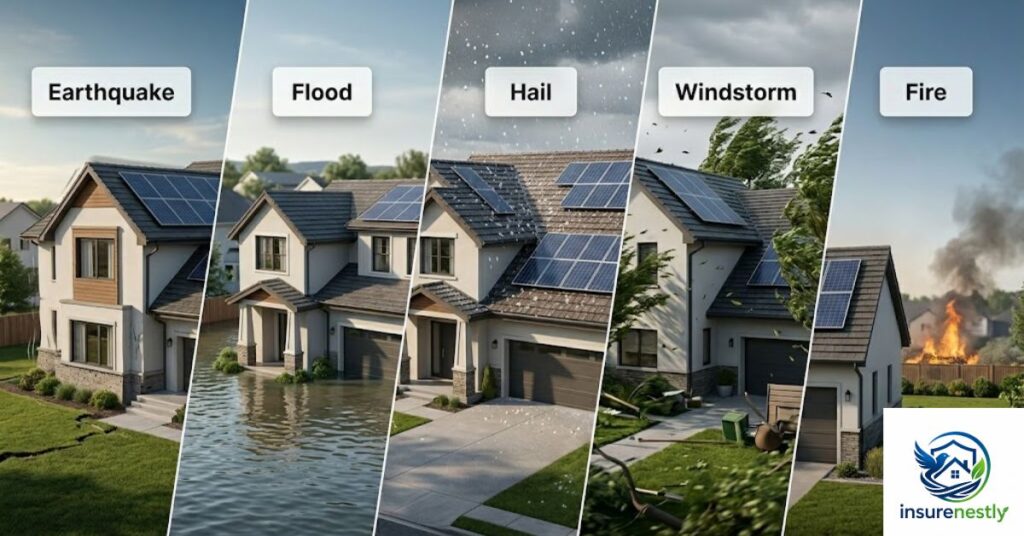
| Event Type | Often Covered | May Require Separate Coverage |
|---|---|---|
| Fire | Yes | No |
| Windstorm | Often | Depends on region |
| Hail | Often | Depends on policy |
| Flood | Usually no | Separate flood insurance |
| Earthquake | Usually no | Separate earthquake insurance |
What Does Hazard Insurance for Home Not Cover?
Hazard insurance covers many sudden events, but it leaves out quite a few common problems. Knowing these gaps helps you avoid unexpected costs later. I have studied many homeowner insurance claims and policies over the years, and these exclusions come up often in real life situations.
Common exclusions homeowners should know
- Flood damage excluded from all standard hazard policies as of 2024, only about 6% of U.S. homeowners carry separate flood insurance, even though approximately 90% of all U.S. natural disasters involve flooding, according to the Insurance Information Institute
- Earthquake damage not covered under standard policies only about 23% of U.S. homeowners had earthquake coverage as of 2020, according to a Triple I Consumer Poll, despite deductibles that can run 2% to 20% of a home’s replacement value
- Wear and tear and maintenance related issues damage that develops gradually over time, such as a slowly leaking roof or aging pipes, is excluded because standard hazard insurance covers only sudden and accidental events
- Pest infestations termite or rodent damage is treated as a preventable maintenance issue and is not covered regardless of how severe the damage becomes
- Intentional damage any loss caused deliberately by the policyholder is excluded and can result in policy cancellation
Hazard insurance vs excluded risks
| Risk | Standard Hazard Insurance | Additional Policy May Be Needed |
|---|---|---|
| Flood | Usually excluded | Yes |
| Earthquake | Usually excluded | Yes |
| Sewer backup | Often limited | Possibly |
| Normal aging | Excluded | No |
This table makes the limits easy to see. Standard hazard insurance focuses on sudden accidents only. For risks like floods or earthquakes, you will need separate coverage in most cases.
How Much Hazard Insurance Coverage Do Homeowners Need?
Figuring out the right amount of hazard insurance can feel tricky, but it is one of the most important decisions for protecting your home. You want enough coverage to rebuild if something goes wrong, without paying for more than you need. After looking at many real homeowner cases, I have seen how getting this part right saves a lot of stress and money later.
Replacement cost vs market value
| Factor | Replacement Cost | Market Value |
|---|---|---|
| Measures | Cost to rebuild | Property sale value |
| Land value included | No | Yes |
| Insurance relevance | High | Lower |
| Used for coverage decisions | Commonly | Less commonly |
This table shows why replacement cost matters more for insurance. It focuses on actual rebuilding expenses, not what your house might sell for.
Factors affecting coverage needs
These factors directly affect how much dwelling coverage you should carry. The most important number to know is your home’s replacement cost what it would actually cost to rebuild from the ground up. According to data from house buyers of america.com, rebuilding a typical home in 2025 costs between $150 and $300 per square foot, meaning a 2,000 sq. ft.
SOURCE: Copeland Insurance
How Much Does Hazard Insurance for Home Cost?
The cost of hazard insurance which forms the dwelling coverage portion of your homeowners policy varies significantly based on location, home value, and risk profile. According to NerdWallet’s analysis of more than 100 insurance companies, the national average cost of homeowners insurance is $2,490 per year (approximately $208 per month) for a policy with $300,000 in dwelling coverage.
SOURCE: NerdWallet
What factors affect hazard insurance premiums?
- Home location the biggest driver Oklahoma homeowners pay an average of $5,858 per year while Hawaii homeowners average just $613, a gap driven almost entirely by storm and disaster exposure, according to Insure.com and NerdWallet’s state level rate data
- Claims history filing even one claim raises your premium by 10% to 40% on average depending on claim type and state; a single water damage claim typically increases premiums by about 25%, according to Insure.com’s analysis of rates across all 50 states
Low risk home vs high risk home insurance costs
| Factor | Lower Risk State Hawaii | Higher Risk State Oklahoma |
|---|---|---|
| Average annual premium | $613 per year | $5,858 per year |
| Difference from $2,601 national average | 76% below national average | 125% above national average |
| Primary risk driver | Low tornado and hurricane exposure; standard policies exclude hurricane damage | Located in Tornado Alley frequent tornadoes and severe convective storms year round |
| Premium after one claim | 10% to 40% increase on already low base rate | 10% to 40% increase on already high base rate significantly larger dollar impact |
| Insurer availability | Standard market multiple carriers compete | Some major insurers restrict new policies or exit state entirely in high risk years |
Hazard Insurance for Home vs Homeowners Insurance
Hazard insurance and full homeowners insurance are often used interchangeably, but they are not the same thing. Hazard insurance refers specifically to the dwelling coverage portion the part that protects the physical structure. A standard homeowners policy bundles this with personal property coverage, liability protection, and additional living expenses. The practical difference matters most at claim time: a homeowner who assumes their policy covers everything may discover that personal belongings, liability claims, or temporary housing costs fall outside what their lender required hazard coverage actually pays. According to the Insurance Information Institute, property damage accounts for approximately 97% of all homeowners insurance claims but liability claims, though less frequent, carry an average payout of $29,880 per claim, a cost that hazard only coverage would not address.
SOURCE: III.org
Key differences homeowners should understand
| Feature | Hazard Insurance | Homeowners Insurance |
|---|---|---|
| Dwelling protection | Yes | Yes |
| Personal property coverage | Limited focus | Often included |
| Liability coverage | Usually no | Usually yes |
| Additional living expenses | Usually no | Often included |
| Overall protection scope | Narrower | Broader |
This table highlights the main differences clearly. Hazard insurance acts as the core part for the house structure.
How Does the Hazard Insurance Claim Process Work?
Filing a claim after your home gets damaged can feel stressful. Knowing the basic steps ahead of time makes the process smoother. Hazard insurance claims follow a fairly standard path, though each company handles details a bit differently. From what I have seen in many homeowner situations, staying organized helps things move faster.
Step by step claim process
| Step | Process |
|---|---|
| Damage occurs | Covered hazard impacts property |
| Report claim | Notify insurer |
| Documentation | Submit photos and evidence |
| Inspection | Adjuster reviews damage |
| Claim decision | Approval or denial |
| Settlement | Repair or reimbursement process |
This table shows the usual flow. Start by contacting your insurance company right away after damage happens. Take clear photos and keep records of everything.
Why are some claims delayed or denied?
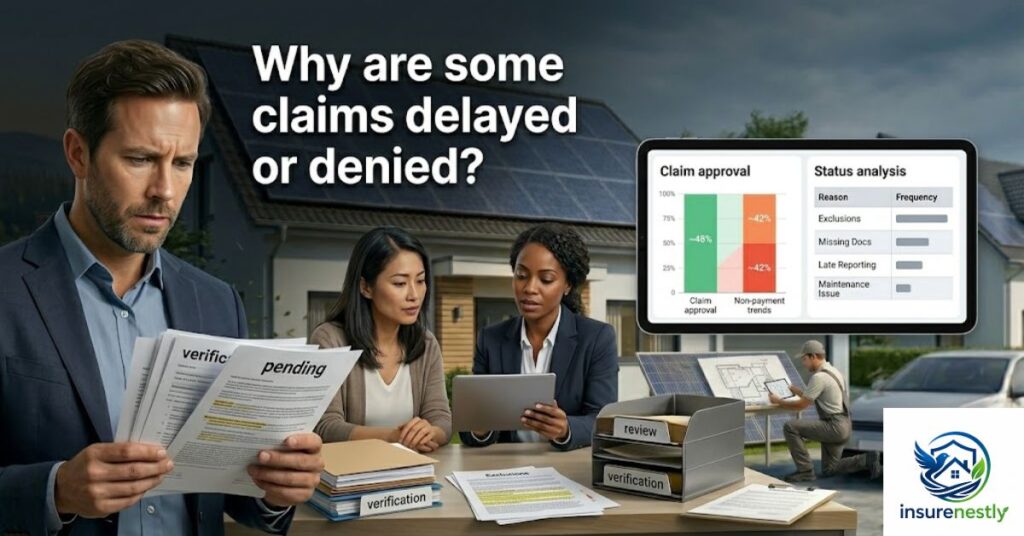
Understanding why claims get denied is increasingly important. According to a June 2025 Weiss Ratings study of 2024 claims data, the 14 largest U.S. homeowners insurers closed 48% of claims without any payment, while nationally across all carriers, 42% of homeowner claims were closed without payment. The most common reasons for denial or non payment include policy exclusions (such as flood or earthquake damage), documentation gaps, late reporting, and damage attributed to pre existing conditions or maintenance neglect. Water damage claims face particularly high denial rates approximately 9 to 10% often because insurers classify the cause as gradual rather than sudden. Filing promptly, documenting damage with photos and receipts, and understanding your policy’s exclusions before a loss occurs are the most effective ways to avoid a denied claim.
Common Mistakes Homeowners Make With Hazard Insurance
Many homeowners think they have enough protection but later face problems when they need to file a claim. Small mistakes with hazard insurance can lead to big financial headaches. After reviewing many real cases, I have noticed the same errors coming up again and again. Avoiding them can save you stress and money.
Underinsured vs adequately insured homes
| Factor | Underinsured Home | Adequately Insured Home |
|---|---|---|
| Rebuilding protection | Limited | More complete |
| Financial risk | Higher | Lower |
| Out of pocket expenses | Higher | Potentially lower |
This table shows why proper coverage matters. Underinsured homes leave you paying more from your own pocket after damage.
Mistakes to avoid
- Carrying too little dwelling coverage approximately 64% of U.S. homes are underinsured, meaning most homeowners would face out of pocket costs even after a total loss claim
- Not updating coverage after renovations adding a room or upgrading a kitchen raises your rebuild cost but does not automatically increase your policy limit
- Ignoring policy exclusions flood and earthquake damage are excluded from standard hazard policies and require separate coverage that many homeowners never purchase
- Choosing coverage based only on price a lower premium often means higher deductibles or gaps in covered perils that only become visible at claim time
Conclusion
Hazard insurance is the foundation of financial protection for any mortgaged home, but the data shows most homeowners carry meaningful gaps. Approximately 64% of U.S. homes are underinsured for rebuilding costs, only 6% of homeowners carry separate flood coverage despite floods being involved in roughly 90% of U.S. natural disasters, and 42% of all homeowner claims nationally were closed without payment in 2024.
Disclaimer
The information in this article is for educational purposes only. It is based on general knowledge about hazard insurance and homeowners policies. Insurance rules, coverage, and requirements can differ greatly by state, insurance company, and individual policy.
This article is not insurance advice, financial advice, or a substitute for talking to a licensed insurance agent or professional. Always review your own policy documents and consult qualified experts before making any decisions about your coverage.
At Insurenestly, we aim to provide clear and honest information to help homeowners understand their options better, but we do not guarantee that the details here will match your specific situation. Please verify everything with your insurer.
FAQs
Why Am I Paying Hazard Insurance on My Mortgage?
Lenders require hazard insurance because your home is collateral for the loan. Fannie Mae and Freddie Mac, which back roughly 70% of U.S. conventional mortgages, set guidelines requiring active hazard coverage for the life of the loan. If your policy lapses, your lender can force place insurance at 2 to 10 times the normal premium cost and add it directly to your mortgage payment.
Do I Need Hazard Insurance for My Home?
If you have a mortgage, hazard insurance is required it is a condition of your loan. Even without a mortgage, it is strongly recommended. According to the Insurance Information Institute, approximately 64% of U.S. homes are underinsured, meaning most homeowners would face out of pocket costs even after a total loss claim. Without coverage, a single fire or storm could leave you responsible for significant rebuild costs.
Can I Remove Hazard Insurance From My Mortgage?
No you cannot remove hazard insurance while any mortgage balance remains. Your lender has a financial interest in the property and requires coverage as a contractual condition of the loan. Once your mortgage is fully paid off, the requirement ends and the choice becomes yours. However, dropping coverage on a fully owned home is a serious financial risk rebuilding after a total loss can cost hundreds of thousands of dollars with no insurance funds to cover it.
What Is an Example of Hazard Insurance?
A house fire is the clearest example. If fire damages your roof, walls, or structure, your hazard insurance pays to repair or rebuild up to your dwelling coverage limit, minus your deductible. Fire and lightning are among the most expensive covered events the Insurance Information Institute reports an average non catastrophe payout of $130,752 per fire claim as of 2024.
When Can I Stop Paying Hazard Insurance?
The lender’s requirement ends when your mortgage is fully paid off. After that, keeping or dropping coverage is your decision. That said, going without coverage is risky according to the Insurance Information Institute, wind and hail alone affects about 1 in 36 insured homes every year, and fire claims average $130,752 per event, meaning an uninsured homeowner absorbs that full cost out of pocket.
What Are the Most Common Hazard Claims?
Wind and hail is the most common claim type, affecting about 1 in 36 insured homes per year. Water damage from burst pipes or overflow affects roughly 1 in 67 homes annually. Fire and lightning is less frequent at 1 in 430 homes per year but the most expensive, averaging $130,752 per claim as of 2024. Theft and vandalism are also common but carry much lower average payouts. All figures are from the Insurance Information Institute.
How Do I Lower My Hazard Insurance Costs?
The most effective ways to lower your premium are raising your deductible, installing safety features like smoke detectors or impact resistant roofing, and bundling your home and auto policies with the same insurer. Shopping quotes from at least three insurers every one to two years also helps, since rates vary significantly by company for the same home and coverage level.
Why Did My Mortgage Add Hazard Insurance?
Your lender added insurance because your existing policy lapsed, was cancelled, or they did not receive proof of active coverage. This is called force placed insurance. It costs 2 to 10 times more than a standard policy and only protects the lender it does not cover your belongings, liability, or temporary living costs. To remove it, submit proof of your own active policy to your lender.
What Are 5 Examples of Hazards Covered by Insurance?
The five most common covered hazards are fire and lightning, wind and hail, water damage from sudden events like burst pipes, theft, and vandalism. Wind and hail affects about 1 in 36 insured homes annually. Fire claims average $130,752 per event as of 2024. Floods and earthquakes are not covered under standard hazard policies and require separate coverage only 6% of U.S. homeowners carry separate flood insurance despite floods occurring in roughly 90% of all U.S. natural disasters, per the Insurance Information Institute.

Hi, I’m Shumail, an independent insurance researcher and content writer. I research different insurance topics and explain them in simple and easy language so that general readers can understand them better.
I am not an insurance agent, broker, lawyer, or service provider. I do not sell any insurance products or offer any financial services. The information shared on this website is purely for educational and informational purposes only.
My goal is to help people understand insurance concepts, policies, and basic guidelines in a clear and simple way through well-researched content.


1 thought on “What Is Hazard Insurance for Home? What Every Homeowner Should Know”
Pingback: California Home Insurance Complete 2026 Coverage Guide