

Car wreck without insurance changes everything about how the next few months go. You can’t file a claim, so the usual insurance playbook doesn’t apply. What replaces it is a mix of state law, personal liability, and decisions you make in the first hour that can either protect you or come back to bite you in court.
How This Article Was Researched
Insurenestly is an independent research platform built to make insurance easier to understand for everyday drivers and homeowners. We don’t sell policies or represent clients. Every fact, figure, and legal point in this article was pulled from primary sources, state law pages, court published rulings, insurance industry data like Insurance Research Council.
Who Has to Pay After a Car Wreck Without Insurance?
Money after a car wreck usually comes from insurance. But when you don’t have a policy, the answer changes fast. It depends on where you live and who caused the crash. About 15.4% of drivers in the US don’t carry car insurance, according to the Insurance Research Council. That means this situation happens more than most people think, and knowing the rules ahead of time can save you real money.
When You Caused the Accident
If you caused the wreck and you don’t have insurance, you pay for the other driver’s damage out of your own pocket. In at fault states, you’re the one legally responsible for their losses. If the other driver sues you, a court can order you to pay their medical bills and repair costs, sometimes over several years. Your house, savings, and paycheck can all be at risk if a judgment goes against you.
When the Other Driver Caused the Accident
If the other driver caused the wreck and has insurance, you can file a claim with their company for your damage. But if they’re also uninsured, there’s no policy to file against. In this case, you’ll likely need uninsured motorist coverage on your own policy to get paid. Without that coverage, your only option may be suing the other driver directly, and collecting money from someone with no insurance is often hard, even after you win in court.
When Both Drivers Share Fault
Sometimes both drivers did something wrong. In most states, this is decided using comparative negligence rules. Each driver gets a fault percentage, and the payout gets reduced by that percentage. For example, if you’re 30% at fault and the other driver is 70% at fault, you can usually recover 70% of your losses from them. A few states use “contributory negligence” instead, where even 1% fault can block you from recovering anything at all.
What Should You Do Before Leaving the Accident Scene?
What you do in the first few minutes after a wreck can decide how your case turns out later. Skipping these steps can cost you proof and money, especially when insurance is missing from the picture.
Evidence You Should Collect
- Photos and videos of both vehicles, license plates, and the damage
- Pictures of the road, skid marks, weather, and any debris
- The police report number and the name of the officer who responded to the accident.
- The names and phone numbers of anyone who witnessed the accident.
- Footage from nearby traffic or security cameras, if any exist
Information You Should Exchange
- Full name and phone number of the other driver
- Driver’s license number
- Insurance company name and policy number, if they have one
- Vehicle plate number and VIN
- Name of the registered owner, if it’s not the driver
Mistakes That Can Hurt Your Case
- Admitting fault at the scene, even just to be polite
- Leaving before police arrive or a report gets filed
- Skipping photos because the damage looks minor at first
- Skipping a medical check up even with no visible injury
- Giving a recorded statement to an insurer before you know all the facts
First Offense Penalties: State by State Comparison
| State | First Offense Fine | License Suspension | SR 22 Required |
| Massachusetts | $500 – $5,000 | 60 days – 1 year | Yes |
| West Virginia | $200 – $5,000 | 30 days | Yes |
| Maryland | $1,000 – $2,500 | Yes | Yes |
| Delaware | $1,500 – $2,000 | 6 months | Yes |
| New York | $150 – $1,500 | 1 year | Yes (FS 1) |
| New Jersey | $300 – $1,000 | 1 year | Yes |
| Mississippi | $150 – $1,000 | 2nd offense only | Yes |
| Wisconsin | $10 – $500 | Yes | Yes |
Source: carregistrationfee.com
Can You Still Recover Money Without Insurance?
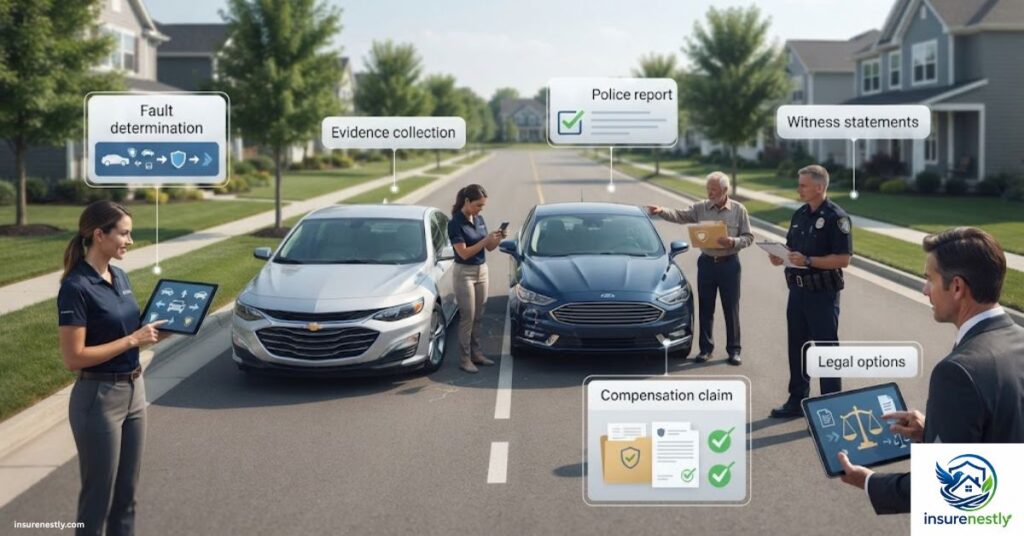
Not having insurance doesn’t automatically mean you get nothing after a wreck. It just means the path to compensation looks different, and it depends on who was at fault and what proof you have.
Situations Where You May Still Recover Damages
If the other driver caused the wreck, you can usually still sue them directly for your damages, even without your own policy. Roughly 1 in 8 drivers in the US don’t carry insurance, so courts see these cases often. You can also recover through the at fault driver’s insurance if they have coverage, since your own policy status doesn’t block that claim. In some cases, a third party, like an employer or vehicle owner, may share liability too.
What Can Reduce or Block Your Recovery
- Being partly at fault, which lowers your payout under comparative negligence rules
- The other driver having no income or assets to collect from
- Missing your state’s deadline to file a claim or lawsuit
- Weak or missing proof that the other driver caused the wreck
- Some states’ “no pay, no play” laws, which limit what an uninsured driver can recover even as a victim
What Evidence Strengthens Your Claim
- A police report naming the at fault driver
- Photos and videos from the scene
- Witness statements and contact details
- Medical records tied directly to the crash
- Repair estimates and receipts for your vehicle
What Expenses Could You Be Personally Responsible For?
If you’re found at fault and you don’t have insurance, several costs can land directly on you, not an insurance company.
Vehicle and Property Damage
You’d owe the other driver for repairs or a replacement vehicle, plus any other property damaged in the wreck, like a fence or mailbox. Without collision coverage, you’d also pay for your own car’s damage out of pocket.
Injury Related Costs
This includes the other driver’s medical bills, ongoing treatment, and lost wages if they couldn’t work because of the wreck. Courts can also add pain and suffering to the amount you owe, which often costs more than the physical damage itself.
Court Ordered Payments
If the case goes to court and you lose, a judge can order wage garnishment, sometimes up to 25% of your take home pay, to collect the debt. Some states also place liens on your property or suspend your driver’s license until the judgment is paid.
What Happens If the Other Driver Has No Insurance Either?
If neither of you has insurance, there’s no company on either side to sort out the claim. Everything moves to a personal level, and often to court.
Your Available Recovery Options
- Filing a personal injury lawsuit directly against the other driver
- Using your health insurance to cover medical treatment first
- Negotiating a private settlement or payment plan with the other driver
- Checking if a third party, like an employer, shares fault
When Collecting Payment Becomes Difficult
Even if you win the lawsuit, getting the money is not always easy. If the other driver has no regular income, savings, or valuable property, you may have to wait years before you receive any payment. Courts can’t force someone to pay money they don’t have, so your attorney will usually check the driver’s finances before you spend time and money filing suit.
When Legal Action May Be the Only Option
If the other driver caused the wreck, has some income or property, and your damages are serious, a lawsuit is often your only real path to compensation. This is especially true for large medical bills or long term injuries, where health insurance and savings won’t cover the full cost. A smaller fender bender may not be worth the cost of a lawsuit.
How Can State Laws Change the Outcome of Your Accident?
The exact same wreck can end very differently depending on which state it happens in. That’s because insurance and fault laws are set at the state level, not federally.
Why Results Differ From One State to Another
At fault states and no fault states handle claims in opposite ways, and that alone changes who you file against. Comparative negligence rules also vary, deciding how much you can recover if you share blame. On top of that, some states require uninsured motorist coverage while others just make it optional, which changes what protection you already have before a wreck even happens.
States With Stricter Uninsured Driver Rules
- Mississippi has the country’s highest uninsured driver rate, at 28.2%, according to the Insurance Research Council
- New Jersey and Massachusetts can suspend your registration right away and fine you $300 to $1,000 for a first offense
- New York enforces some of the harshest uninsured driver penalties in the country under its Vehicle and Traffic Law
- Massachusetts and West Virginia carry first offense fines that can reach $5,000
Why Local Laws Matter Before Making Decisions
Before you accept a settlement, skip a lawsuit, or assume you have no options, check your specific state’s rules. What counts as “at fault,” how much you can recover, and what deadlines apply all shift from state to state. A decision that makes sense in one state could cost you money in another.
What Can Make Your Situation Worse After the Crash?
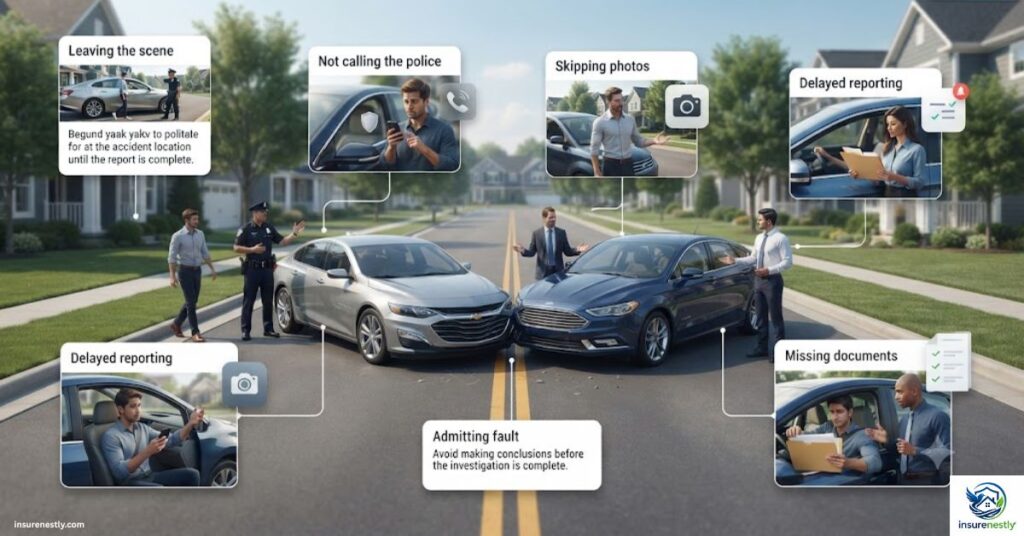
Some mistakes cost more than the accident itself. These come up often, and each one can weaken your case or add legal trouble on top of the wreck.
Leaving the Scene Too Early
Driving off before police arrive, even for a minor bump, can turn into a hit and run charge. Most states treat this as a misdemeanor when it’s only property damage, but it becomes a felony if anyone is hurt, with penalties that can include jail time, fines, and license suspension. Staying at the scene, even when it’s tempting to leave, protects you legally far more than it costs you in time.
Giving Incorrect or Incomplete Information
Guessing at details, rounding numbers, or leaving out facts on a police report can come back to hurt you later. Insurers check every report line by line, and small mismatches between your statement and the evidence can be used to deny or reduce a claim. Stick to what you actually saw and know, and let photos and witnesses fill in the rest of the picture.
Missing Important Legal Deadlines
Every state sets a statute of limitations, the deadline to file an injury or property damage claim, and it usually runs between one and six years depending on the state. Kentucky and Louisiana give you as little as one year for injury claims, while Maine and North Dakota allow up to six. Miss the deadline, and courts will dismiss your case no matter how strong your evidence is.
Conclusion
A car wreck without insurance isn’t the dead end it feels like in the moment. What decides the outcome isn’t the lack of a policy, it’s what you do right after: the evidence you collect, the information you exchange, and how fast you act once your state’s clock on filing starts ticking.
Before anything else, find out whether your state runs on fault or no fault rules, check what your own policy actually covers if you have one, and talk to a local attorney if the damages go beyond a fender bender. Those three steps decide whether you walk away owing money, or getting paid what you’re actually owed.
Disclaimer
This article is for research and educational purposes only. Insurenestly is an independent research platform, not a law firm, insurance company, or claims adjuster, and nothing here should be treated as legal or financial advice for your specific situation.
Insurance laws and fault rules vary by state and change over time, so always confirm current requirements with your state’s DMV or insurance department before making a decision.
Reference and Source:
- Source: nolo.com
- Source: munley.com
FAQs
Will my health insurance pay for injuries from a car wreck without insurance?
Yes, in most cases. Health insurance doesn’t check who’s at fault or whether you had auto coverage; it pays your medical bills like it would for any other injury, minus your deductible and copays. It won’t cover the other driver’s costs or your vehicle damage, but it’s often the fastest way to get treatment started while a claim or lawsuit works itself out .
What if I was a passenger, not the driver, in an uninsured car wreck?
Passengers are almost never held responsible for a crash, insured or not. You can file a claim against whichever driver caused the wreck, and if that driver has no insurance, you may be able to use their uninsured motorist coverage if they have any, or your own if you’re covered under a family policy.
Will I get arrested on the spot for a car wreck without insurance?
Usually not, just for lacking coverage. Most states treat it as a civil or traffic offense that leads to fines and license suspension, not jail. That changes fast if you also leave the scene, since fleeing after a wreck is a separate criminal charge that can carry real jail time.
How much will my insurance cost go up after driving without coverage?
A coverage lapse alone typically raises your premium by 20% to 50% once you’re required to file an SR 22, though a DUI or at fault accident on top of it pushes that higher. The exact number depends on your state and driving history, so it’s worth comparing quotes from a few insurers before renewing.

Hi, I’m Shumail, an independent insurance researcher and content writer. I research different insurance topics and explain them in simple and easy language so that general readers can understand them better.
I am not an insurance agent, broker, lawyer, or service provider. I do not sell any insurance products or offer any financial services. The information shared on this website is purely for educational and informational purposes only.
My goal is to help people understand insurance concepts, policies, and basic guidelines in a clear and simple way through well-researched content.