Insurance for house cleaners is coverage that protects you from the cost of accidents on the job things like broken items property damage or client injuries. Most independent cleaners need general liability insurance while cleaning businesses with staff also need workers’ compensation and bonding. Without it you pay these costs yourself.
About the Author
Shumail is the founder and researcher behind Insurenestly an independent insurance research platform focused on helping U.S. consumers understand car and home insurance. Through in depth articles interactive calculators and data driven tools Shumail breaks down complex insurance topics coverage types cost factors and policy comparisons into clear practical information.
Insurenestly’s content is built on thorough research using verified industry data from licensed insurance providers and established industry sources. Shumail is not a licensed insurance agent and does not sell insurance policies; Insurenestly’s role is strictly informational helping readers ask the right questions and make informed decisions before speaking with a licensed agent in their state.
Why Do House Cleaners Need Insurance?
House cleaning looks like simple work but it comes with real risks. You are inside someone else’s home working around their furniture floors and personal items. A single mistake can result in property damage, an injury, or a client complaint. Insurance protects you from the financial side of these risks so one bad day does not turn into a big loss.
Accidents Can Happen Anytime
No matter how careful you are accidents do not send a warning first.
- You might slip on a wet floor and hurt your back
- A cleaning chemical could spill and stain a carpet
- You could trip while carrying supplies and break a vase
- A client’s pet might get injured because a door was left open
These aren’t hypothetical risks real claims filed by cleaning business owners include a housekeeper’s equipment hitting a wall and leaving a hole a cleaner using the wrong solution on furniture and damaging it and another accidentally spilling cleaning solution down a client’s sink and damaging the pipes.
A Small Mistake Can Cost a Lot
A tiny mistake in someone’s home can turn into a big bill.
- Scratching a hardwood floor with a heavy vacuum
- Using the wrong cleaner on marble and damaging it
- Breaking an expensive item while dusting a shelf
- Accidentally leaving a window open causing water damage
Clients expect you to fix or pay for the damage. Without insurance this comes straight from your income. With insurance the policy covers the repair or replacement cost.
Insurance Gives You Peace of Mind
When you know you are covered you can focus on doing good work instead of worrying about what might go wrong. Clients also trust cleaners who carry insurance more than those who do not. It shows you take your job seriously and you are prepared for the unexpected. This peace of mind makes the job less stressful for you and more trustworthy for the people who hire you.
What Does House Cleaner Insurance Cover?
House cleaner insurance is not just one thing. It usually covers a few different areas so you are protected no matter what goes wrong on the job. Knowing what each part covers helps you pick the right policy instead of paying for coverage you don’t need.
Damage to a Client’s Property
This is the most common type of claim for house cleaners.
- Broken furniture decor or electronics
- Stains on carpets rugs or upholstery
- Scratched floors walls or countertops
- Water damage from spills or leaks
For example one cleaning professional accidentally spilled cleaning solution down a client’s sink and damaged the pipes the type of incident property damage coverage is built to handle.
Injuries and Liability Claims
Liability coverage protects you if someone gets hurt because of your work.
- A client slips and falls on a floor you recently cleaned.
- A visitor trips over your equipment or cord
- A pet gets injured due to a cleaning product left out
- You accidentally cause an allergic reaction with a chemical
If a claim like this happens liability insurance covers medical bills and legal costs. Without it you could be paying these expenses for years.
Your Tools Equipment and Vehicle
Your work depends on your equipment so it needs protection too.
- Vacuums mops and cleaning machines
- Chemicals and supplies you carry daily
- A work vehicle used to travel between clients
- Tools stolen from your car or storage
This part of the policy covers repair replacement or theft. It keeps your business running even if your equipment gets damaged or stolen.
Which Type of Insurance Is Right for You?
The right policy depends on how your cleaning work is set up. A solo cleaner has different needs than someone running a full team. Picking the right type saves you money and keeps you covered where it matters.
| Cleaner Type | Coverage Needed | Typical Annual Cost |
| Solo Cleaner (no employees) | General liability $1 million per occurrence / $2 million aggregate | $525 per year ($44/month) |
| Cleaning Business Owner | General liability + business owner’s policy (BOP) + janitorial bond | $832 per year ($69/month) for BOP plus bond |
| Business With Employees | General liability + workers’ compensation + bond | $1 395 per year ($116/month) for workers’ comp on top of liability |
Source: insureon.com
If You Work Alone
If you clean homes by yourself you mainly need basic liability coverage.
- Covers property damage at a client’s home
- Covers injury claims if something goes wrong
- Usually low cost since it’s just you
- Easy to get started with minimal paperwork
For example Maria a solo house cleaner carries a general liability policy at around $112 per month to stay covered for her day to day client visits.
If You Own a Cleaning Business
Once you run your own cleaning business your risks grow.
- General liability for damage and injury claims
- Coverage for your business equipment and supplies
- Commercial auto insurance if you use a work vehicle
- Bonding which builds trust with new clients
A business level policy protects both your income and your reputation.
If You Have Employees
Hiring staff means you need coverage for them too.
- Workers’ compensation for on the job injuries
- Liability coverage that includes employee mistakes
- Coverage for injuries caused by your staff at a client’s home
- Protection against employee theft claims
This keeps your business safe from claims caused by your team not just yourself.
What Can Change the Cost of Your Insurance?
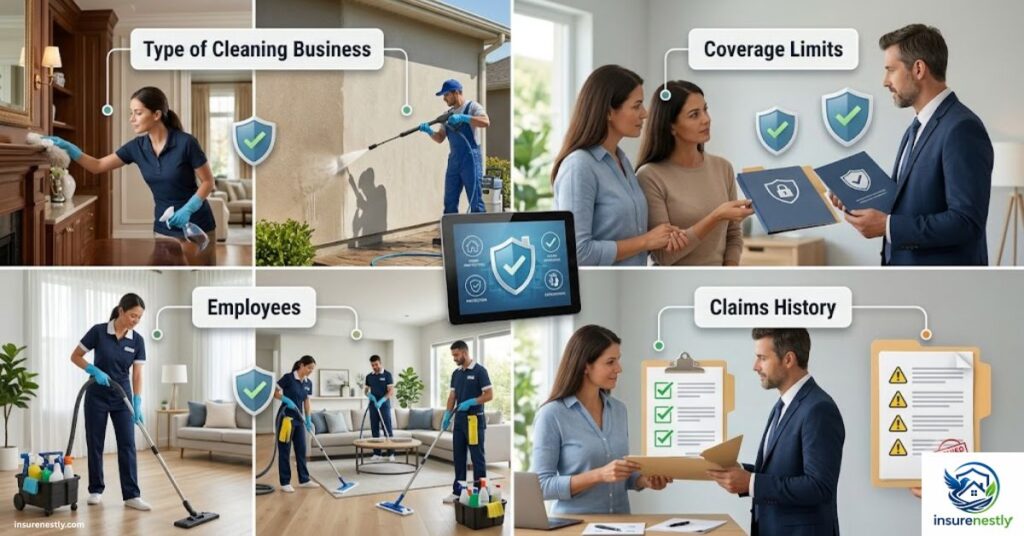
Insurance cost is not the same for everyone. A few factors decide whether you pay more or less. Knowing these helps you understand your quote instead of just guessing why the price is high or low.
| Factor | Lower Cost Example | Higher Cost Example |
| Type of Cleaning Business | House cleaning averages $44/month | Pressure washing averages $75/month (higher damage risk) |
| Coverage Limits | $1 million liability limit costs less | $2 million limit costs more |
| Employees | Solo operator no payroll | Workers’ comp required by law once you hire staff |
| Claims History | Clean claims history keeps rates lower | Frequent past claims raise renewal price |
The Services You Offer
Some cleaning services carry more risk than others.
- Basic dusting and vacuuming costs less to insure
- Deep cleaning with chemicals raises the risk
- Window cleaning at height adds more cost
- Move in/move out cleaning often means higher liability
The more risk involved the more your premium reflects it.
The Size of Your Business
Your business size directly affects your insurance price.
- A solo cleaner pays the least
- A small team with 2 3 workers pays more
- A larger company with many employees pays the most
- More revenue usually means higher liability limits needed
Insurers look at how much exposure your business has overall.
Your Coverage Limits
Higher limits mean more protection but also a higher price.
- Low limits keep your premium cheap but risky
- Higher limits protect you in serious claims
- Some clients require a minimum coverage limit
- Choosing the right limit balances cost and safety
Pick a limit that matches the size of the jobs you take on.
Insurance and Bonding Are Not the Same
| Feature | Insurance | Janitorial Bond |
| What It Covers | Injury claims property damage false advertising | Covers client loss if an employee steals from them |
| Who It Protects | Your business from lawsuits and claims | Builds client trust required for some contracts |
| Typical Annual Cost | $525/year for general liability | About $130/year |
What Insurance Covers
Insurance covers accidents that happen during your work like a broken vase a client injury or damaged flooring. It protects you when something goes wrong by mistake not on purpose. This is the coverage that pays for repairs medical bills or legal costs when an accident occurs while you’re cleaning.
What a Bond Covers
A bond is different. It protects your client if you or your employee steals something or acts dishonestly. If a client’s jewelry goes missing after a cleaning visit a bond can cover their loss. It’s not about accidents it’s about theft and dishonest behavior on the job.
Do You Need Both?
Most professional cleaners carry both. Insurance handles accidents and bonding builds trust with clients who worry about theft. Having both together makes your business look more reliable especially when clients are comparing you to other cleaning services in your area.
How to Choose the Right Insurance Policy
Picking a policy is not just about grabbing the first quote you see. You need to think about your specific work compare your options and actually read what you’re signing up for. A little effort here saves you from problems later.
Know What You Want to Protect
Before you buy anything think about what matters most to your business.
- Your equipment and supplies
- Your income if a claim happens
- Your reputation with clients
- Your employees if you have any
This helps you pick a policy that actually fits your work instead of one that’s just cheap.
Compare More Than Just the Price
The cheapest policy is not always the best one. Look at what’s included not just the monthly cost. A low price with weak coverage can cost you more later if a real claim comes up. Compare coverage limits exclusions and claim history of the insurer before deciding.
Read the Policy Before You Buy
Always read the policy details yourself don’t just trust what you’re told. Check what’s covered what’s excluded and how claims are filed. Ask questions if something is unclear. This small step can save you from a denied claim later when you need the coverage the most.
Common Mistakes to Avoid
Even smart cleaners make mistakes when buying insurance. These mistakes usually show up at the worst time right when you need your coverage to work. Avoiding them from the start saves you money and stress later.
Buying the Cheapest Policy
Going for the lowest price feels smart but it often means weak coverage. Cheap policies sometimes skip important protections just to keep the cost low. When a real claim happens you may find out the hard way that it’s not covered. Price matters but it should never be the only thing you look at.
Not Reading the Exclusions
Every policy has things it does not cover and this list matters more than people think. Some cleaners skip this part and assume everything is included. Later when a claim gets denied they realize a specific situation was excluded all along. Always read the exclusions carefully before you sign anything.
Waiting Until Something Goes Wrong
Some cleaners wait to get insurance until after an accident happens but by then it’s too late. Insurance only protects you going forward not for things that already occurred. Getting covered early before you take on clients is the only way to stay protected from day one.
Simple Ways to Protect Your Cleaning Business
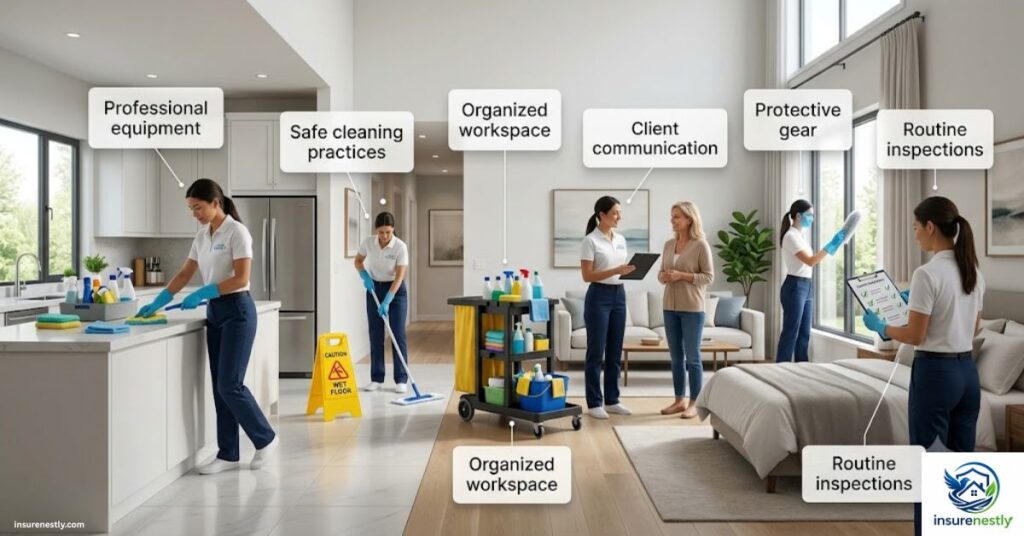
Insurance is important but it’s not the only thing that keeps your business safe. Your daily habits and how you run things also play a big role. These simple steps lower your risk and make claims less likely in the first place.
Use Safe Cleaning Practices
Good habits prevent most accidents before they happen.
- Test new chemicals on a small area first
- Use mats to avoid slippery floors
- Store cleaning tools away from walkways
- Handle fragile items with extra care
Using safe work practices helps reduce accidents and lowers the chances of filing an insurance claim.
Keep Good Records
Records protect you when a client disputes something.
- Take photos before and after each job
- Keep a list of your regular clients
- Save receipts for equipment and supplies
- Note any damage that was already there
Good records give you proof if a disagreement ever comes up.
Talk Clearly With Your Clients
Clear communication avoids a lot of problems.
- Explain what your service includes
- Tell clients about any existing damage you notice
- Set expectations before you start cleaning
- Confirm details in writing when possible
This builds trust and reduces the chance of a misunderstanding turning into a claim.
Final Thoughts
House cleaning comes with real risks a broken item a slip on a wet floor a client claim you didn’t see coming. Insurance is what stands between one bad accident and a financial setback you can’t recover from. Whether you work alone or run a team the right coverage protects your income your equipment and your reputation.
Start with general liability if you’re just starting out then add workers’ compensation and bonding as your business grows. Don’t wait for something to go wrong before you get covered and don’t just pick the cheapest policy without checking what it actually includes. Read the details compare your options and talk to a licensed insurance agent to confirm the right coverage and cost for your state and business size.
Disclaimer
The information in this article is intended for general guidance only and is not a substitute for insurance, legal, or financial advice. Insurance coverage requirements and costs vary by state insurer business size and individual circumstances. The figures and examples mentioned in this guide are based on publicly available industry data and are meant to give you a general idea not an exact quote.
Before purchasing any insurance policy we strongly recommend speaking with a licensed insurance agent or broker in your state to get accurate coverage options and pricing based on your specific business needs. Insurenestly does not sell insurance policies and is not responsible for any decisions made based on the information provided in this article.
FAQs
Do house cleaners legally need insurance?
Most states don’t require solo house cleaners to carry general liability insurance by law but many clients and cleaning contracts still require proof of it before hiring you.
How much does house cleaner insurance cost?
General liability insurance for house cleaners averages $44 per month or $525 per year with standard $1 million per occurrence and $2 million aggregate limits.
Does a client’s homeowner’s insurance cover damage caused by a cleaner?
Not reliably. Without the cleaner’s own general liability insurance a client would typically have to file a claim against their own homeowner’s policy with their own deductible and rate impact to cover damage the cleaner caused.
What’s the difference between insurance and a janitorial bond?
General liability insurance covers accidental damage or injury caused during a cleaning job. A janitorial bond is a separate financial guarantee that reimburses the client specifically for theft or dishonesty by a cleaner or employee.
Do solo self employed cleaners need workers’ compensation?
It’s not always legally required for a solo operator with no employees but it’s often recommended since a self employed cleaner isn’t covered by anyone else’s workers’ comp policy if they’re hurt on the job.

Shumail is an independent insurance researcher and content writer who researches publicly available insurance information and explains coverage, costs, and insurance concepts in simple language. InsureNestly provides educational and informational content only and does not sell insurance or provide insurance advice.